A suspended driver’s license does not become valid simply because the trip is short, necessary, or connected to a holiday. If your Illinois driving privileges are suspended, relying on assumptions about when or where you can drive can create additional legal problems.
Halloween makes a useful reminder because many everyday trips can feel harmless: driving a few blocks to a party, taking children trick-or-treating, heading to work, or making a quick trip to a store. But the purpose or distance of a trip does not by itself create permission to drive on a suspended license.
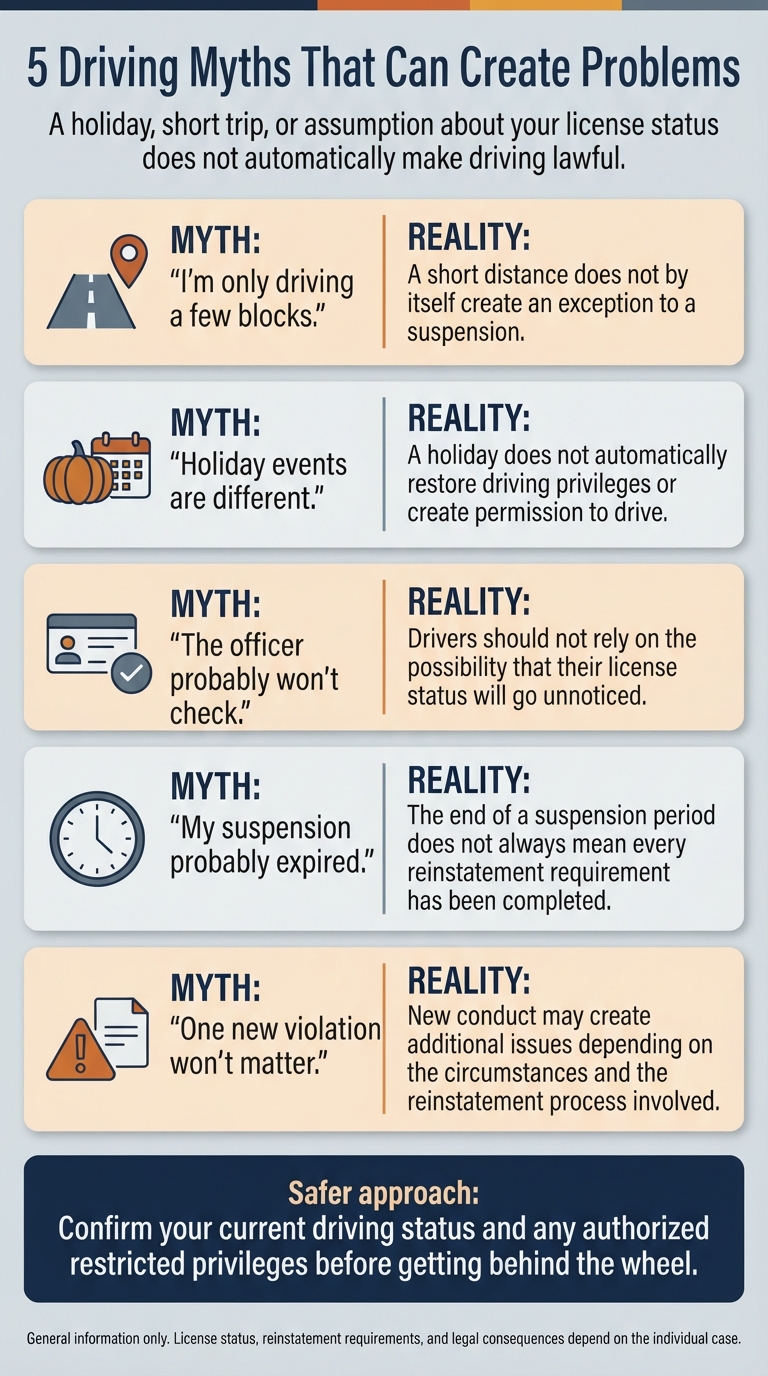
Myth #1 — “I’m Only Driving a Few Blocks”
One of the most common assumptions about driving while suspended is that a very short trip somehow carries less legal risk.
Why Drivers May Believe It
A driver may think there is little harm in traveling only around the neighborhood or making a quick trip nearby.
The reasoning is understandable: the trip is short, the roads are familiar, and the driver may not expect to encounter law enforcement.
But the length of the trip does not determine whether the driver’s privileges are valid.
Why Distance Does Not Create an Exception
If your driving privileges are suspended, driving a few blocks is still driving. A short trip does not by itself change whether your driving privileges are valid.
The important question is whether you currently have legal authority to drive, not how far you plan to travel.
Drivers who are unsure about their status should verify it before driving rather than assuming that a short distance makes the trip permissible.
Myth #2 — “Holiday Events Are Different”
Halloween parties, trick-or-treating, school activities, family gatherings, and other seasonal events can make transportation more complicated.
That does not mean Illinois license restrictions disappear for the evening.
The Common Misconception
A driver may assume that a holiday event creates more flexibility, especially when the trip involves children or family responsibilities.
Others may believe there are special Halloween checkpoint laws that somehow change whether a suspended driver may lawfully operate a vehicle.
Those are separate questions.
Checkpoint rules are separate from the question of whether a driver is legally authorized to drive.
The Legal Issue Remains Your License Status
The central issue is whether you are legally permitted to drive.
A holiday does not, by itself, restore suspended privileges.
There also should not be an assumption that Illinois conducts a particular statewide Halloween checkpoint program every year. Any specific 2026 Halloween enforcement announcement should be confirmed through an official source.
For a suspended driver, however, the practical rule is simpler: do not rely on the holiday as an exception to the suspension.
Myth #3 — “The Officer Won’t Check My License Status”
Some drivers assume that a traffic stop will concern only the reason they were pulled over.
That is a risky assumption.
Why Someone Might Think This
A driver may believe that if the vehicle is insured, the registration is current, or the initial traffic issue is minor, the status of the driver’s license will not matter.
But license status is part of the information that may become relevant during a traffic stop.
Do Not Base Your Decision on Whether You Think You Will Be Checked
A traffic stop can involve checking a driver’s license status, so drivers should not assume a suspension will go unnoticed.
The exact systems and procedures can vary. The important point is that a driver should not rely on avoiding a license-status check.
Whether an officer checks immediately or later does not change the driver’s underlying license status.
If there is uncertainty about whether a suspension remains active, confirm that status through an authoritative Illinois source before driving.
Myth #4 — “My Suspension Probably Expired”
A driver may remember receiving a suspension for a particular period and assume that the license automatically becomes usable once that period has passed.
That assumption can be dangerous.
Why This Confusion Happens
People often think of a suspension like a countdown:
“The suspension lasted a certain amount of time, so once that date passed, I must be able to drive again.
The actual status may be more complicated.
Suspension Ending and Reinstatement Are Not Always the Same Thing
The end of a suspension period should not automatically be treated as proof that driving privileges have been restored.
Depending on the circumstances, additional steps may be required before the driver is legally permitted to drive again.
Those requirements can vary according to the reason for the suspension and the driver’s record.
Before driving, confirm that the Illinois Secretary of State actually shows your privileges as valid rather than relying on the date you believe the suspension ended.
An Illinois license suspension attorney can also help explain the status of a particular case when the reinstatement requirements are unclear.
Myth #5 — “One Violation Won’t Affect My Hearing”
Drivers working toward reinstatement sometimes focus only on the original event that caused the suspension or revocation.
They may assume that new conduct will be treated as unrelated.
That is not a safe assumption.
Why Drivers May Separate the Two Issues
Someone may think:
- 1the hearing concerns an older case;
- 2the new incident is minor;
- 3the violation has nothing to do with the original suspension; or
- 4one additional issue will not matter.
But reinstatement proceedings can involve consideration of the driver’s record and circumstances.
New Conduct Can Create Additional Issues
A new violation may complicate a driver’s situation in ways that depend on the nature of the violation, the driver’s existing record, and the type of reinstatement proceeding involved.
A new citation does not produce the same result in every case. Its effect depends on the circumstances and the reinstatement process involved.
But a driver preparing for reinstatement should not assume that recent conduct is irrelevant.
If a new incident occurs while a reinstatement matter is pending, it may be appropriate to discuss the situation with a lawyer before proceeding.
Why These Myths Can Create New Problems
The common theme behind these myths is assumption.
Each myth relies on an assumption about distance, holidays, enforcement, license status, or recent conduct instead of the driver’s actual legal status.
The possible suspended license consequences in Illinois depend on the circumstances, including why the driving privileges were suspended, the driver’s history, and the nature of any new alleged violation. That is why broad statements such as “you will only get a ticket” or “one violation always leads to jail” should be avoided.
The more useful question is: What is my current driving status, and what am I legally permitted to do right now?
That question should be answered before driving, not after a traffic stop.
What to Do Instead of Relying on a License Suspension Myth
If you believe your Illinois license is suspended, start by confirming your current status through the Illinois Secretary of State.
Then determine:
- 1why your privileges are suspended;
- 2whether any reinstatement requirements remain;
- 3whether a hearing is required;
- 4whether you currently have any legally authorized restricted driving privileges; and
- 5what steps may apply before full driving privileges can be restored.
A lawyer familiar with license suspension matters can help interpret the record and explain which requirements may apply to a particular situation.
The goal is not merely to avoid another violation. It is to understand what must happen before lawful driving can resume.
FAQ
QWhat if I only drive to work?
Driving to work is not automatically permitted simply because employment is important.
Some drivers may qualify for restricted driving privileges depending on their circumstances, but eligibility and permitted uses are case-specific.
Do not assume that a work trip is allowed unless your current driving authority actually permits it.